Investment
Investment is undertaken by firms when they purchase capital equipment or hold stocks which are waiting to be converted into goods. In national income accounts, investment represents the most volatile element - volatility can largely be explained through the 'accelerator effect'.
Gross and net investment
Gross investment is total investment spending, including the purchase of new capital equipment, and capital to replace old technology or equipment.
Net investment refers to investment spending on new assets that can be used to increase a firm's capacity to produce. Net investment is gross investment, less any depreciation (also called capital consumption).
Example for a whole economy
| Year | Gross investment | Depreciation | Net investment |
|---|---|---|---|
| 2018 | 50bn | 40bn | 10bn |
| 2019 | 70bn | 50bn | 20bn |
| 2020 | 100bn | 60bn | 40bn |
Net investment in an economy is, perhaps, more significant than gross investment given that net investment will increase the productive potential of an economy [and shift its production possibility frontier outwards].
In advanced economies, investment contributes around 15% to aggregate demand.
Investment, risk, and opportunity cost
For firms, investment is a risk in that investment decisions are made on the assumption that existing demand will be maintained or increase.
All investment decisions involve a risk. This is because the cost of the investment may not generate a net benefit in the future - in other words, future benefits may not exceed costs. Generally, the benefits of investment are measured in terms of future profits, which arise when revenue exceeds cost.
Investment appraisal
Investment appraisal is undertaken by firms (and by the state when considering investment in social capital projects) to calculate the expected value of a decision to invest.
Firms commonly estimate the 'net present value' (NPV) of an investment decision. This means looking at the expected flow of benefit from the investment [for example, the cash flowing over the life of the asset], which is then 'discounted' by the expected rate of interest, less the initial capital cost of the machine.
The expected flow of benefit, in terms of cash, is discounted by the future expected interest rate to reflect opportunity cost.
For example, if a capital asset costs £120,000 to purchase, it may generate extra cash of £25,000 per year for the life of the asset - let us assume 8 years.
The benefit in terms of cash flow is therefore, £200,000 (before the capital cost of £120,000 is deducted).
However, there is an alternative use of the £120,000 - namely, putting it into an interest-bearing account, and earn interest. Hence, the cash flow of £200,000 must be discounted to allow for the loss of interest on the investment.
The process is not simply about a one-off interest calculation, but a compound calculation as the interest in year one is rolled forward into year two, and so on. So, when the discounting has taken place, and the initial capital cost is factored in, the net present value on the above investment will be much less than the undiscounted £80,000. So long as the net present value is a positive number, the investment may go ahead. In practice, investment appraisal is most common when making a decision between several different investment options. The option with the highest positive net present value is the one most likely to be chosen.
The investment appraisal process provides some clues as to the determinants of aggregate investment.
Factors affecting investment include:
- Interest rates - interest rates can affect investment spending in three related ways. Firstly, capital spending may be funded by borrowing, and hence any change in the borrowing rate may affect the cost of investment, and decisions to investment. Secondly, the interest rate represents an ‘opportunity cost’ to producers. Saving in an interest-bearing account is an alternative to spending on capital, and any change in rates alters the opportunity cost of investment. For example, if rates rise from 5 to 7%, capital investment becomes relatively less desirable. Finally, changes in rates affect business confidence – a rise in rates may signal further rises and a period of monetary contraction.
- National income and the current state of the economy – changes in income can trigger larger than proportionate changes in the level of investment through the accelerator effect. The extent of this depends upon another determinant – business confidence. If producers believe that an upturn in national income signals a period of growth, then it is likely that they will purchase more capital goods than they need in the short run. Also, capital goods tend to be indivisible – and it may not be possible to increase investment by small and gradual amounts. Hence, an increase in national income of just 3% may trigger a much larger increase in investment. This also means that if an economy moves into a downturn, or a full-blown recession, investment spending may collapse.
- Confidence and expectations - confidence is a significant determinant of investment decision-making. Given that investment is a sacrifice, firms must feel confident that they will get a positive return from their investment. Keynes famously referred to 'animal spirits' in explaining why confidence and decisions to invest are affected by a 'herding instinct' that may defy rational analysis. In other words, entrepreneurs may have completed careful investment appraisal which indicates that a particular decision will result in a good return but may still delay an investment decision because other entrepreneurs in their industry are delaying theirs. This is one reason why Keynes advocated public sector investment to counteract any negative private sector 'sentiment'.
- Policy – finally, government can influence investment though its choice of policies. For example, firms can be given tax relief on its capital spending, and some firms may benefit from subsidies to purchase capital equipment.

The demand for investment is inversely related to the rate of interest. In the demand for investment diagram, at an interest rate of 6%, demand for investment will be relatively low, at 300bn. However, at a much lower rate of 2%, demand for investment will increase to 600bn. This is because the net present value of investments will rise as interest rates fall.
The effects of the financial crash and pandemic

We can see that investment is very sensitive to changes in the state of the macro-economy. Investment dipped sharply in the UK, and around the world, following both the financial crisis and the COVID-19 pandemic.
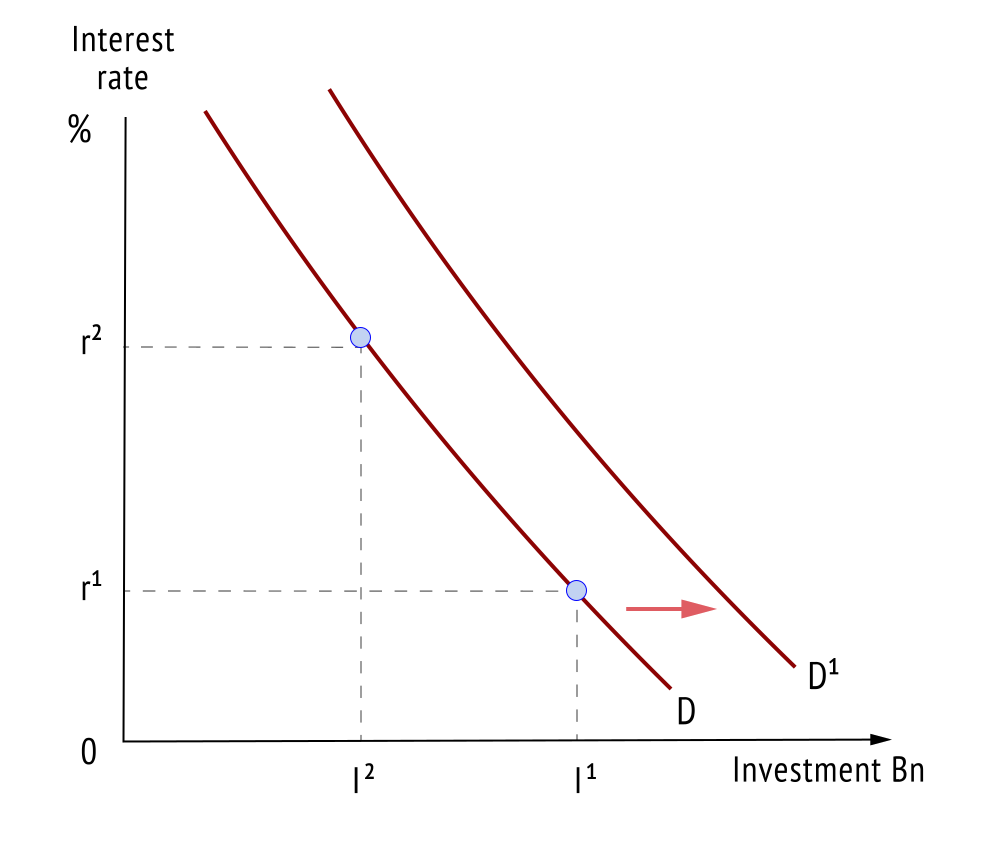
While changes in the rate of interest cause the demand for investment to expand or contract (via a movement along the curve) changes in other determinants, such as positive expectations, or an improvement or worsening in the state of the economy, will cause the demand for investment curve to shift at all interest rates.