


Demand, supply and market equilibrium
Equilibrium
Economic theory states that there will be a single price at which demand equals supply – called ‘equilibrium price’.
Consumers would prefer to pay as little as possible, and producers would like to sell for as much as possible. However, if there is no flexibility in how price is arrived at, transactions will not take place.
This means that consumer demand is unsatisfied, and the seller earns no revenue. Hence, both parties have a strong incentive to modify their position and adjust the price they will accept.
In order to satisfy a want or a need and gain utility, rational consumers will readjust their assessment of what they are prepared to pay, and will increase the price they will accept - without doing this, their demand will go unsatisfied.
In contrast, rational producers must sell goods and services gain revenue, and to derive a profit. If they fail to sell the goods or services they offer, and 'take to market' they will not satisfy their need to make a profit. Like consumers, they will readjust their expectations, and will be prepared to reduce priceto make a sale.
Economic theory predicts that slowly, through incremental adjustment, or 'price discovery' price will slowly converge and eventually reach a level both parties will accept. When this price is reached the market is in equilibrium.
At equilibrium the market ‘clears’ - there are no shortages or surpluses and marginal utility equals marginal cost.
Also at equilibrium, economic welfare is maximised. (see equilibrium and welfare video)
Example
Consider the following information for demand and supply at various prices.
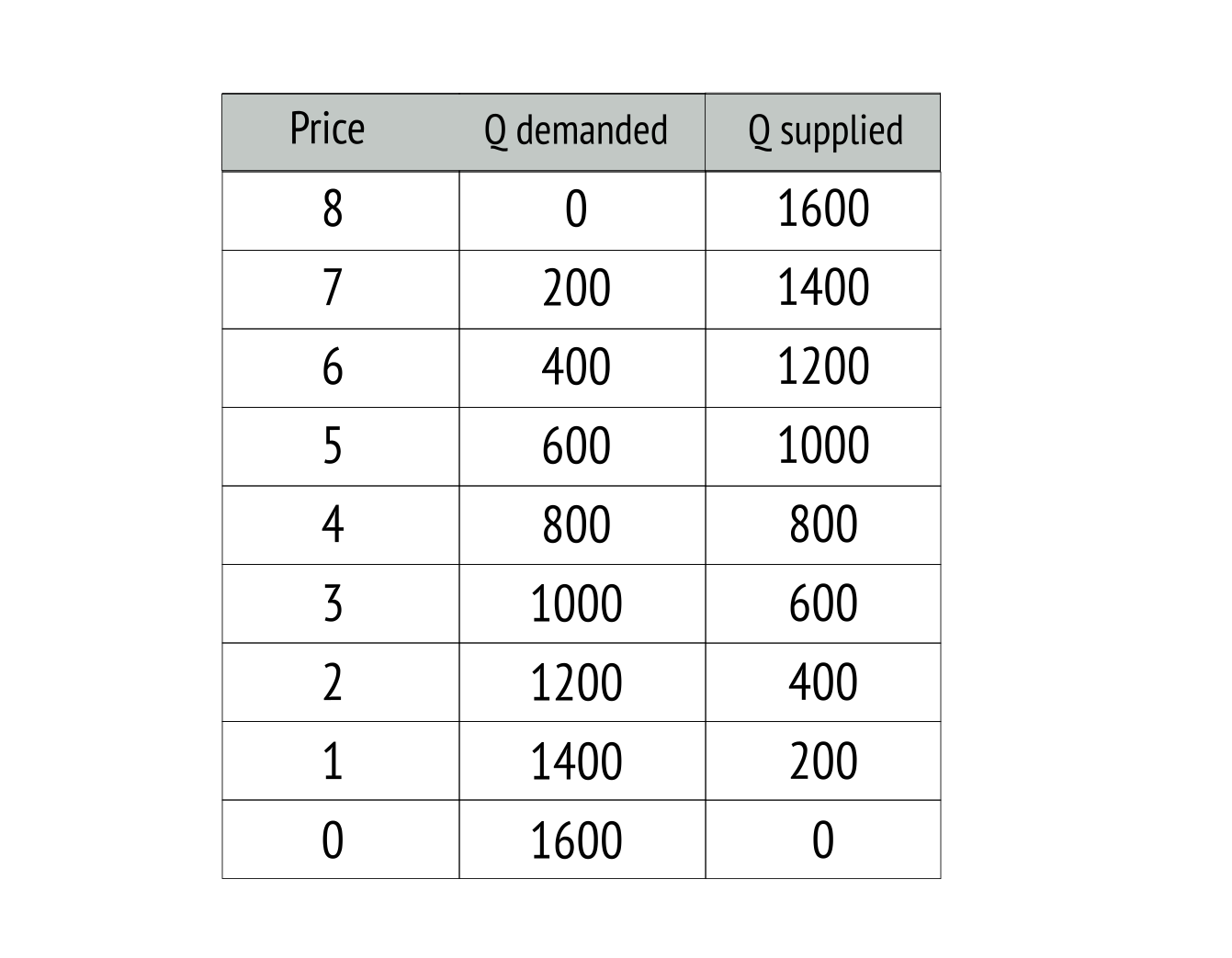
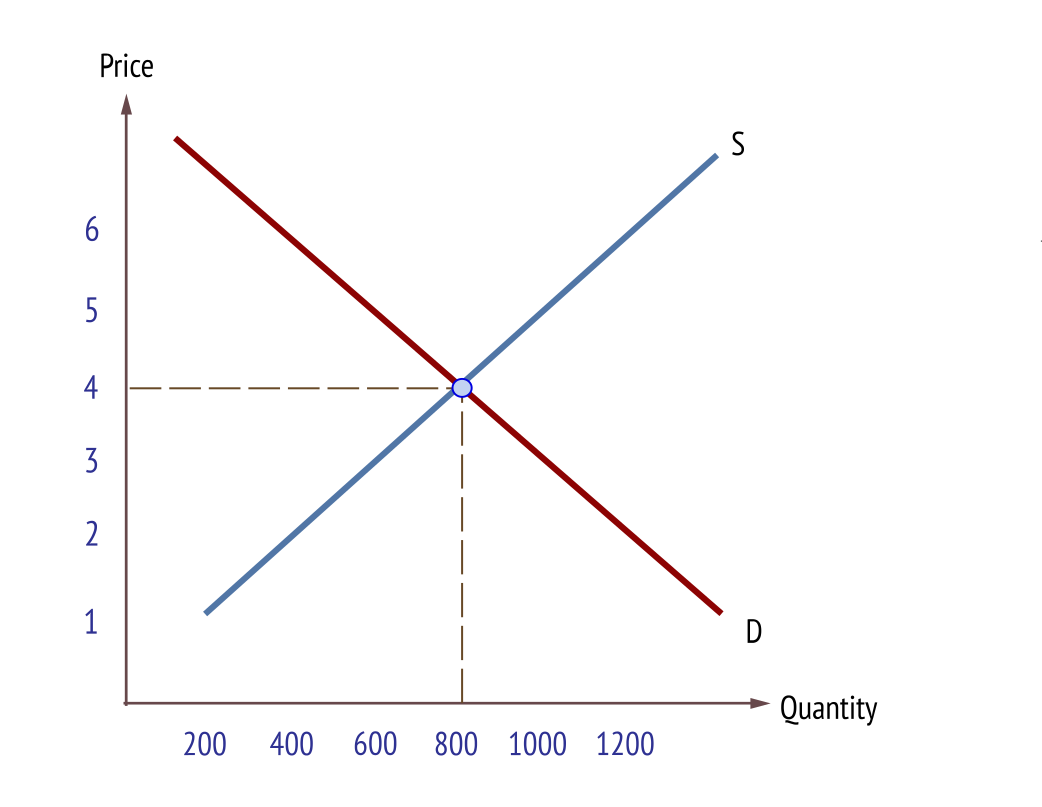
There is only one price at which the market clears - all that is brought to market by producers is bought by consumers - namely, a price of 4. This is equilibrium price.
Assuming the market is 'free' and consumers and producers are free to enter and have perfect knowledge, then only a price of 4 will prevail.
Disequilibrium prices of more than 4, and less than 4 will result in excess supply or excess demand, and the market will not clear.

Disequilibrium prices are inefficient
We can ask what will happen if consumers and producers do not adjust what they are willing to pay, or willing to accept? Or, what will happen if the government fixes a price that is not the market equilibrium price?
If the price is set too high, demand will contract and supply extend as the price signalling system starts to operate. This will lead to a surplus, and stocks will build up, requiring extra storage, distribution to warehouses, additional insurance and staffing costs.
If the price is set too low, there will be excess demand, with a shortage - queues will form, waiting lists may be needed, and consumers may waste considerable time queuing and waiting for the good or service. In addition, 'unofficial markets' may emerge and a 'shadow economy' may form.
In the above example, if price is set below 4, demand exceeds supply, and queues will build up. The incentive is now for producers to raise price towards a stable (market-clearing) equilibrium price.
For all these reasons, non-equilibrium prices are considered inefficient and, if free to do so, both consumers and producers will change their behaviour.
Of course, if producers and consumers are not free to adjust their behaviour, permanent market disequilibrium can arise. In Cuba, where prices are fixed by the state, considerable shortages exist, with widespread rationing of essential goods.
Disequilibrium price creates an opportunity cost as resources could have been better used elsewhere.

Video on equilibrium
EquilibriumChanges in equilibrium
Shifts in demand
A change in the position of a demand curve indicates a change in the 'underlying determinants' of demand rather than a change in price.
A demand curve will shift to the right (at D1) if demand increases at all prices. It is important to note that this is referred to as a shift in order to distinguish it from an extension of demand (along the existing demand curve).
Increases in demand

The effect of the increase in demand is to raise the equilibrium price and quantity. This is because at the old price, P, there would be an excess of demand and a temporary disequilibrium. This is resolved when the firm increases supply (through an extension, e to e1 to meet the new demand. A new equilibrium is established at price P1.
Decreases in demand
A decrease in demand is shown with a shift to the left of the demand curve.

The effect of the decrease in demand is to reduce the equilibrium price and quantity. This is because at the old price, P, there would be an excess of supply and a temporary disequilibrium. This is resolved when the firm decreases supply (through a contraction, e to e1) to meet the new demand. A new equilibrium is established at price P 1.
Causes of shifts
Several factors can cause a shift in a demand curve, including:
- Changes in income - which can affect consumer demand in two fundamental ways. In the case of normal goods, income and demand are positively related - an increase in income increases demand, and a reduction in income reduces demand. However, in the case of inferior goods, the relationship between income and demand is inverse - an increase in income reduces demand and a reduction in income increases demand. For example, as income rises individuals are likely to consume more 'luxury' (normal) goods and less basic (inferior) necessities.
- Changes in the price of substitutes will also affect demand, with a fall in the price of a substitute leading to a shift of demand to the left, and a rise in the price of a substitute causing demand to shift to the right.
- Changes in the price of related products, such as complements, will also shift the demand curve. For example, a fall in the price air travel may lead to a rise in the demand for overseas holidays.
- Changes in consumer's tastes and preferences will also affect demand. The demand for gym memberships has increased as more people to improve their levels of health.
- Changes in consumer expectations about the probability of an event, or regarding the need to purchase a good or service at some point in the future. For example, having heard that the price of a product is likely to increase in the future a consumer might alter there current consumption and make the purchase 'today' rather than wait. Consumers may speculate about price changes in the future and alter there current consumption. This is especially true in terms of the demand for financial securities, and exchange rates.
- Demand can also be influence by changes in the nature of the population - such as when a population ages - and changes in natural factors, such as changes in weather causing changes in the type of clothing demanded.


Shifts in supply
A shift of a supply curve is caused by a change in an underlying condition of supply, such as the cost of raw materials, rather than the price of the good or service, which creates an extension or contraction of supply.
A shift of supply to the right
In the graph, S1 represents an increase in supply, where the supply curve shifts to the right.

The impact of the increase in supply is to reduce price and quantity. The market adjusts to the temporary excess supply (at P) by settling at a lower price (P1).
A shift to the right (at S1) is an increase in supply which could be caused by;
- More available raw materials;
- An increase in the supply of labour;
- Subsidies on goods or services;
- A reduction in taxes;
- Unusually good weather or other beneficial supply factors.
A shift to the left in supply

The impact of the decrease in supply is to raise price and quantity. The market adjusts to the temporary excess demand by settling at a higher price.
A shift of a supply curve to the left (at S2) is a decrease in supply. A shift in supply to the left could be caused by:
- Less available raw materials;
- More expensive raw materials;
- A reduction in the supply of labour;
- Taxes on goods or services;
- Bad weather or other disruptive natural events.