


Revenue
A firm's revenue is the income it derives from selling a given quantity of a good or service at a particular price.
There are two revenue cases depending on the market that the firm operates in:
- Firstly, where price is set by the market - and where the firm is a price taker. Price taking occurs when the firm is operating in a 'perfectly competitive' market. In this case, the price is determined through the interaction of demand and supply in the market. Each firm then 'takes' this price, and is not able to diverge.
- Secondly, when the firm can set its own price, and become a price maker. Firms can set their own price when the market has some imperfections, such as where barriers to entry exist, or where there is information failure.
Go to revenue schedules for a numerical example.
Measuring revenue
Revenue can be measured in terms of total, average, and marginal values, as shown:
| Total revenue (TR) = | Quantity sold x price (QxP) |
|---|
| Average revenue (AR) = | TR | |
|---|---|---|
| Q |
| Marginal revenue (MR) = | ΔTR | |
|---|---|---|
| ΔQ |
Marginal revenue is the additional revenue from selling one extra unit.
From the above we can see that average revenue and price have the same value. If AR = TR/Q, then AR = PxQ/Q, which equals P.
While considering total and average values is important, economics is distinguished from other economic and financial disciplines by its interest in marginal values. Indeed, the ‘marginal revolution’ in economics involved the attempt to understand economic decision making by looking at very small changes in costs, revenue and utility.
A revenue schedule shows how much revenue would be earned by a firm at different levels of output. There are two different types of firms in terms of revenue - revenue for firms that cannot influence price, and those that can. Firms that cannot influence price are called price takers and those that can are called price makers.
Revenue schedule for the price taker
In the case of the price taker firms cannot set the price itself. In the example, a price of £15 exists whatever the quantity sold. The price is set by the interaction of demand and supply in the whole market. This type of market is said to be perfectly competitive.
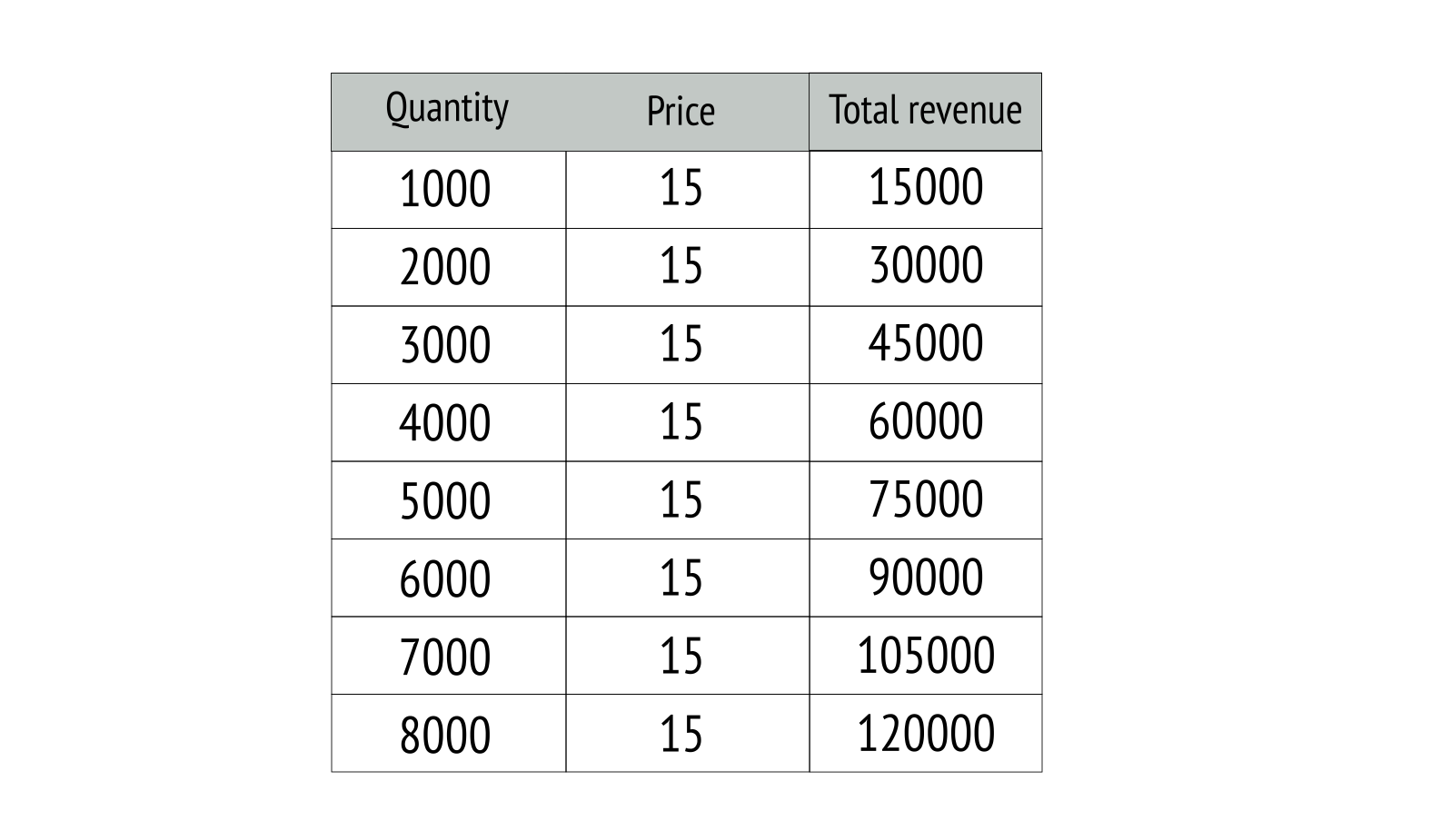
Revenue graph for the price taker

Given that price (AR) is constant it will be equal to marginal revenue (MR), and the AR and MR curves will be horizontal, as shown.
Example
Assuming the firm can set its own price at £18, sales will be 3000 units per day, and revenue will be £54,000. If the firm reduces price to £14, it can sell 7000 units, and earn a total revenue of £98,000. The complete schedules and graph are show below:
Revenue schedule for the price maker

Revenue graph for the price maker

Given that price (AR) falls it will fall at half the rate of marginal revenue (MR), as shown.